
The Only 6 Lifts You Actually Need
Six movements build almost your entire body. Here’s exactly how to train each one.

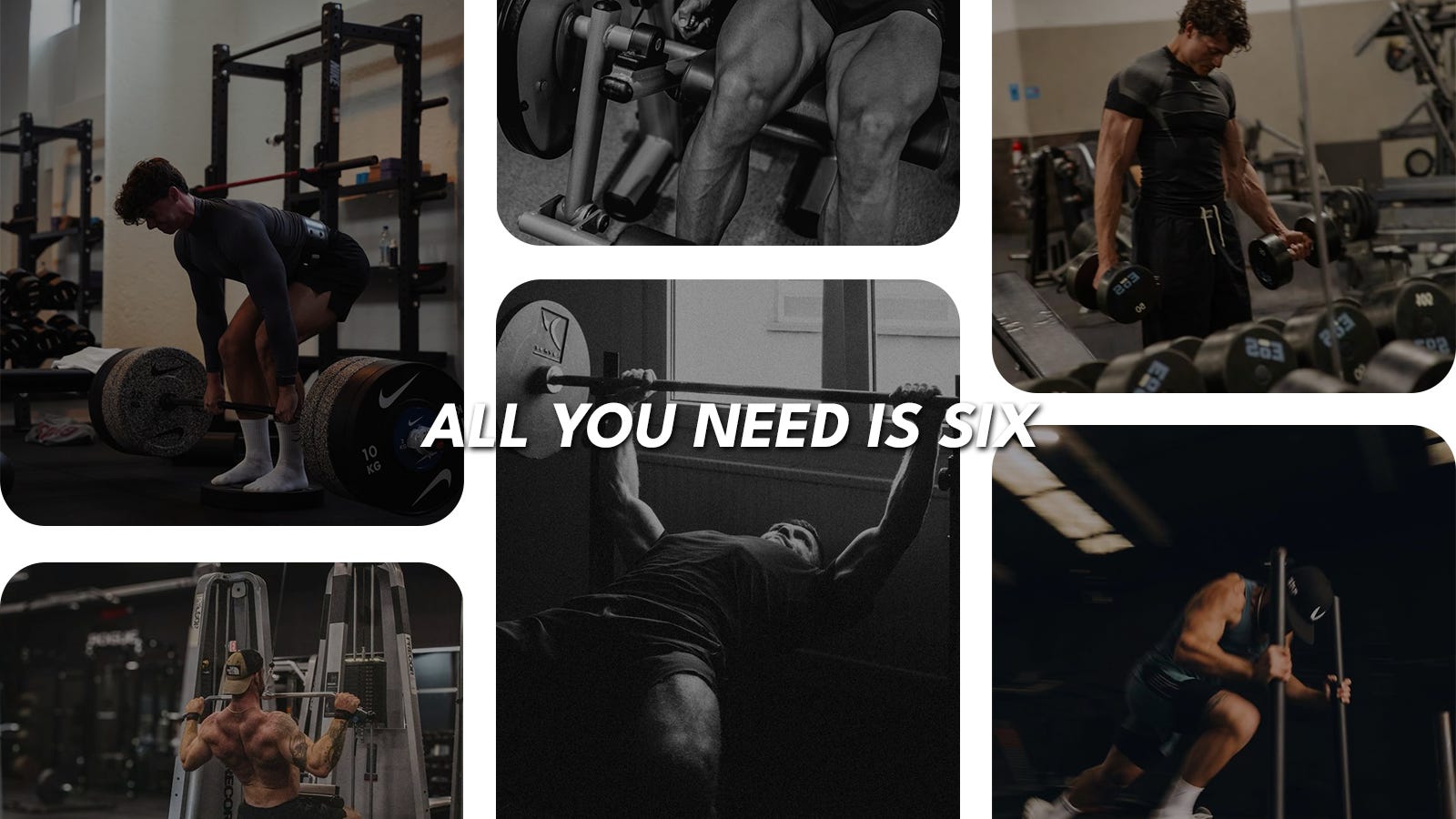
HOUSE RULES #01
You’ve been training for months. Maybe years. You show up, you grind, you leave sore, and somehow the guy in the mirror still looks a lot like last year’s.
Most people assume that means they need to work harder, find the perfect split, or add more exercises. So they do. They bounce between machines, swap programs every few weeks, and pile on isolation work until they’re running forty different exercises and can’t tell you what half of them are even for.
Here’s what almost nobody says out loud: your entire physique runs on about six movements. Six. Get strong at those, and most of what you’re chasing with the other forty starts showing up on its own.
The catch is that knowing the six isn’t the same as running them. Which ones, how heavy, how often, and how to build a week around them: that’s the part that actually changes your body, and the part almost everyone skips. So let’s not.
Here’s the whole thing, start to finish. The six movements and why they cover almost your entire body, then exactly how to run them: how to perform each one, how many sets and reps, how heavy, how often, and two simple weekly templates built from them. All of it grounded in what the research actually shows, so you can stop guessing.
What actually builds a body
So let’s start with the part you don’t have to guess about at all. The one thing about building muscle that isn’t up for debate: it grows when you make a movement harder over time. You add weight, you add reps, and your body finally has a reason to build. That’s the entire engine. Progressive overload. Almost everything else is a detail.
Now look at what forty exercises does to that engine. You do each move a little, never long enough to get strong at it, and by next month you’ve swapped half of them for something new you saw online. Nothing ever gets heavier, because you’re never on the same lift long enough to load it. You’re busy, you’re sweaty, you’re sore, and your body sits there unchanged because nothing is actually progressing.
The way out is to pick a few movements and get relentlessly strong at them. And your body makes that simple, because underneath all the exercises, it only runs a few basic patterns:
You squat.
You bend down and pick things up.
You push things away from you.
You pull things toward you.
Every lift worth doing is one of those patterns with a load on it, and there are only a handful of them in the whole catalog.
I’ve trained enough people to call this before they finish their first month. The ones who pick a few lifts and chase the numbers on them, week after week, build real and obvious bodies. The exercise-collectors, new circuit every session, Notes app full of moves, mostly stay exactly the same. And it usually isn’t for lack of effort. They’re often the hardest workers in the room. They’re just spreading that work so thin that none of it lands.
The six compound movements
So here’s where to put all that work instead. Six movements, and between them, they train nearly every muscle you own.
The squat. Loading your body and standing back up. Builds your quads, your glutes, and the base of full-body strength everything else stands on.
The hinge. Bending at the hips to pull something heavy off the floor, the deadlift and its cousins. Builds your entire back side: hamstrings, glutes, spinal erectors, grip. The muscles that make you look strong from behind and actually be strong.
The horizontal push. Pressing weight away from your chest, like a bench press or a push-up. Builds your chest, front delts, and triceps. The classic “how much you bench” muscles.
The horizontal pull. Pulling weight toward your torso, any kind of row. Builds your mid-back and rear delts, pulls your shoulders back where they belong, and gives you real width from the side.
The vertical push. Pressing weight straight overhead, the overhead press. Builds your shoulders and locks in that capable, fills-out-a-shirt look.
The vertical pull. Pulling your own bodyweight up to a bar, a pull-up or a lat pulldown. Builds your lats and biceps, and it’s where the V-taper comes from.
Run your eye down that list and notice what’s missing: nothing. Legs, back, chest, shoulders, arms, the whole posterior chain, all covered by six patterns. Almost every one of those forty machines you’ve been rotating through is just one of these six movements.
So now you’ve got the whole map: six movements, your whole body.
What you don’t have yet is the instructions.
Because a squat is only as good as how you perform it, how heavy you load it, and how often it shows up in your week. Get those wrong and the best lift in the world builds nothing. Get them right and these six are genuinely all you need.
Here’s exactly what’s coming:
Every one of the six, broken all the way down. How to perform it, the common mistake that kills your results, the exact sets and reps, how hard to push, and how long to rest.
Two ready-to-run weekly plans. A 2-day and a 3-day, built entirely from these movements. Pick one and start this week.
The progression. How to keep adding weight instead of spinning your wheels, so you’re stronger every month.
Every rep range and rest time here comes straight from the research. Let’s get into it.
