
The One Body Part That Makes You Look Athletic, Not Just Big
The body part guys treat as a punchline is the one that decides whether you look athletic or top-heavy.

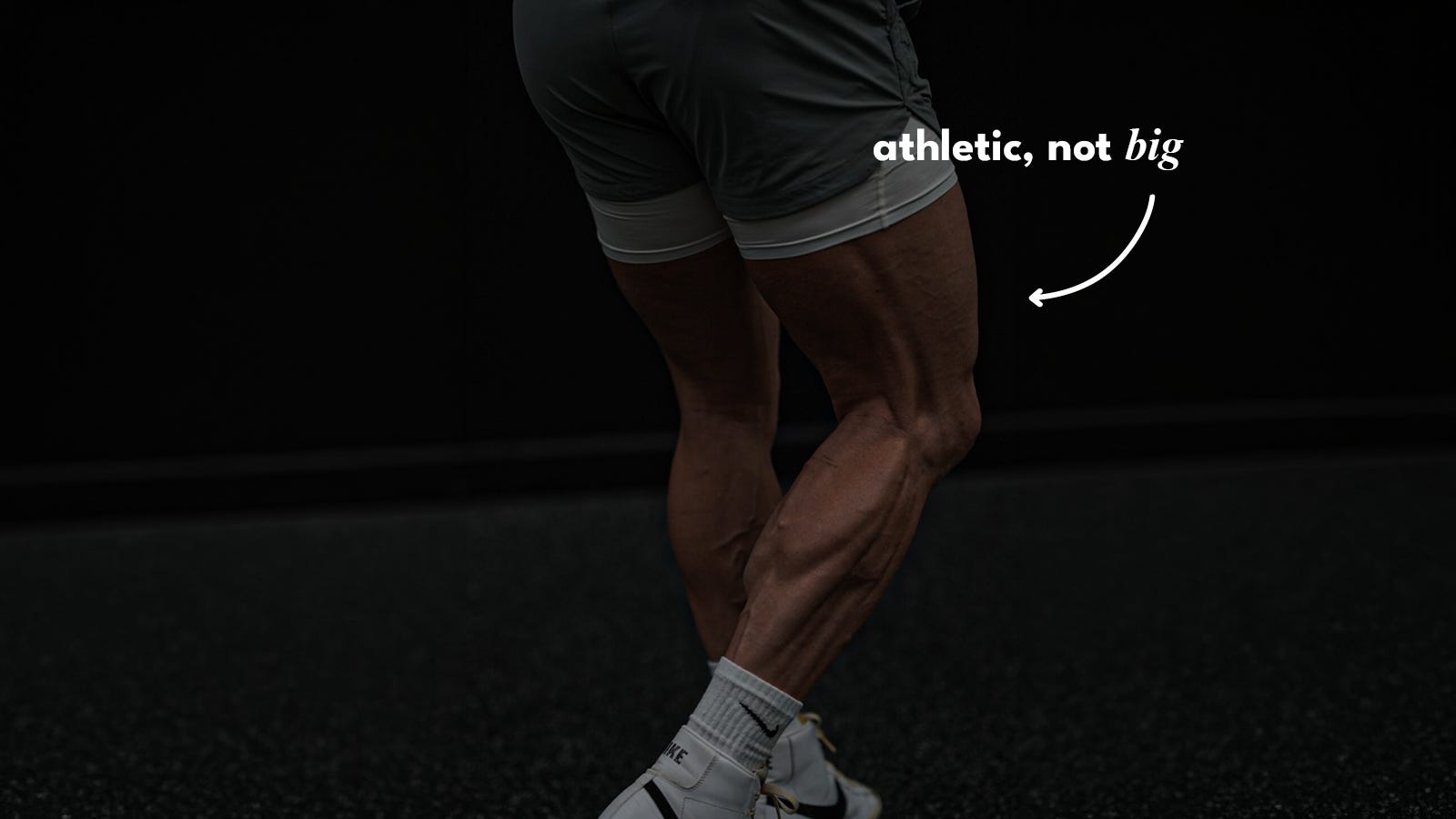
You know the joke. Never skip leg day. It’s on half the shirts in the gym, it’s the caption under every photo of some guy with a massive upper body balanced on two tiny legs, and we all think it’s funny. Then most of us go and quietly skip leg day anyway.
And you’ve seen where that ends up. The guy with the big chest and arms who somehow still looks a little off, like the top half and the bottom half belong to two different people. It reads as unfinished, honestly. Like he trains for the mirror and stops at the waist. Nobody says it to his face, well some might, but everybody notices it at least.
Now picture the guys who look genuinely athletic instead, the ones who look strong just standing there in a pair of jeans. Almost every time, they train their legs. That solid, put-together look isn’t an accident, and it isn’t the arms doing it. It’s the base holding up everything above it.
Which is the whole point of this. The body part everybody’s agreed to treat as a punchline is the exact thing that decides whether you look athletic or just top-heavy. And it might be the best-value work in the entire gym, honestly, for the simple reason that almost nobody actually bothers with it.
THE WHOLE IDEA
If you take nothing else from this, take these three lines.
You don’t look top-heavy because your chest and arms are too big. You look that way because you skipped the biggest muscles you own. The fix is an addition, not a subtraction.
Legs are the biggest lever you’ve got for how athletic you look, bigger than any amount of extra arm or chest work. Nothing above the waist makes up for what’s missing below it.
The work is simple and the field is almost empty. A few hard compound lifts a couple of times a week is most of the job, and because so few guys stick with it, it’s the fastest edge available to you.
WHY LEGS DECIDE THE WHOLE LOOK
Start with what your eye is actually doing when it reads someone as athletic. It isn’t reacting to one big muscle. It’s reading proportion, the way the whole body hangs together. A heavy upper body sitting on thin legs breaks that, because there’s nothing underneath to balance it. It looks like a light bulb, wide and round up top, narrow and flimsy at the base, and people pick up on the imbalance before they notice anything else about you.
Legs are the base that fixes it. When your lower half matches your upper half, the whole frame reads as solid, like it was built on purpose instead of in a mirror. You look powerful just standing there, because a real set of legs quietly says you do more than pose, that you can actually run, jump, and carry things. And it shows the second you put on normal clothes. A pair of jeans either fills out or hangs loose, and that comes down almost entirely to what you’ve built below the waist. It’s the part nobody photographs and nobody talks about, which is exactly why it’s the thing that separates the guys who look genuinely trained from the guys who just look like they lift.
WHAT YOUR LEGS ARE ACTUALLY MADE OF
So that’s the case for training them. It’s worth knowing what’s actually down there too, because “legs” isn’t one muscle, it’s four groups doing four different jobs. You don’t need the Latin names or a physiology degree. You just need to know what each one is and what it gives you, because that’s what makes the routine make sense.
Quads, the front of your thigh. The showpiece. They straighten your knee, and they’re what fills out the front of your jeans and gives your legs that capped, athletic look from the front.
Hamstrings, the back of your thigh. They bend your knee and drive your hips. They add the real thickness from the side and behind, and they’re what stop your legs looking flat the moment someone sees you from anywhere but straight on.
Glutes, your backside. The biggest and strongest muscle you own. They’re the engine behind anything powerful, jumping, sprinting, picking heavy things up, and they’re the base that makes your whole lower half look solid instead of skinny.
Calves, below the knee. They finish the leg off. Nothing makes a pair of shorts look emptier than big thighs sitting on two twig calves, and they’re the one part that usually needs its own direct work to grow.
None of this is worth memorizing. The takeaway is simpler than that: your legs are the biggest, strongest chunk of muscle on your whole body. Which makes what most guys actually do with them pretty strange.
WHY EVERYONE SKIPS THEM
So why does almost nobody train them properly? A few honest reasons. The first is the mirror. Your chest, arms, and shoulders are all right there in the reflection, so they get the attention and the effort, while your legs are behind you and out of sight, easy to forget and even easier to skip. The second is that legs are just hard. A real set of squats takes something out of you that a set of curls never will, the kind of deep, whole-body tired that makes it very tempting to find a reason to cut the very next set short. And the third is that it’s easy to fake. You can do a few sets on the leg-extension machine, feel a decent burn, and walk out convinced you trained legs, without ever going near the heavy compound work that actually builds them.
Put those together and you get a gym full of guys with a solid top half and nothing underneath it. Which, if you’re willing to do the boring, uncomfortable version, is the whole opportunity. The bar is sitting on the floor. Almost nobody is stepping over it, so the guy who does starts to stand out fast.
THE ROUTINE THAT BUILDS THEM
So here’s the doing part, and it’s shorter than you’d think. Four movements, and that’s genuinely most of the job. Screenshot it if you need to.
Squat. 3 to 4 sets of 6 to 10 reps.
Romanian deadlift. 3 sets of 8 to 12 reps.
Lunge or split squat. 2 to 3 sets of 10 to 12 each leg.
Calf raise. 3 to 4 sets of 12 to 20 reps.
Run that 2 to 3 times a week, and add a rep or a little weight whenever a session starts to feel easy. That slow progression is the whole engine.
IF A LIFT DOESN’T AGREE WITH YOU
Swap it, don’t skip it. Each of the four has a gentler version, so a stiff back or a bad knee is never a reason to write off the whole day.
Stiff lower back. Swap the deadlift for a hip thrust, and the barbell squat for a goblet squat.
Beat-up knees. Swap the barbell squat for a box squat, and the lunge for a leg press.
Shaky ankles or balance. Swap the lunge for a split squat, and hold the rack for support.
Same four movements. Just the versions your body is happy to do for years.
THE JOKE WAS RIGHT
So the meme had it the whole time. Never skip leg day isn’t just something people say, it’s the rare bit of advice everyone repeats and almost nobody actually takes. Do the boring version. A few hard lifts, a couple of times a week, for a few months. Legs are slow to show up, but when they finally do, they don’t just change your legs. They change the way the entire rest of you reads.
You can’t build a body that turns heads from the waist up.
RBLT
Alright, be honest with me: when’s the last time you actually trained legs hard, and not just a couple of lazy sets on the machine on your way out the door?
No shame, we’ve all been there. Let’s talk about it!
About RBLT
The fitness world is very good at making a simple thing feel impossible. RBLT is the simple version of getting in shape: how to train, eat, sleep, handle your head, and hold a standard, in plain language, none of the noise. If you’re done chasing the next hack and just want to get in shape and get on with your life, you’re in the right place.