
How to Build a Back That Fills Out a Shirt
The half you can’t see is the half that makes you look big.

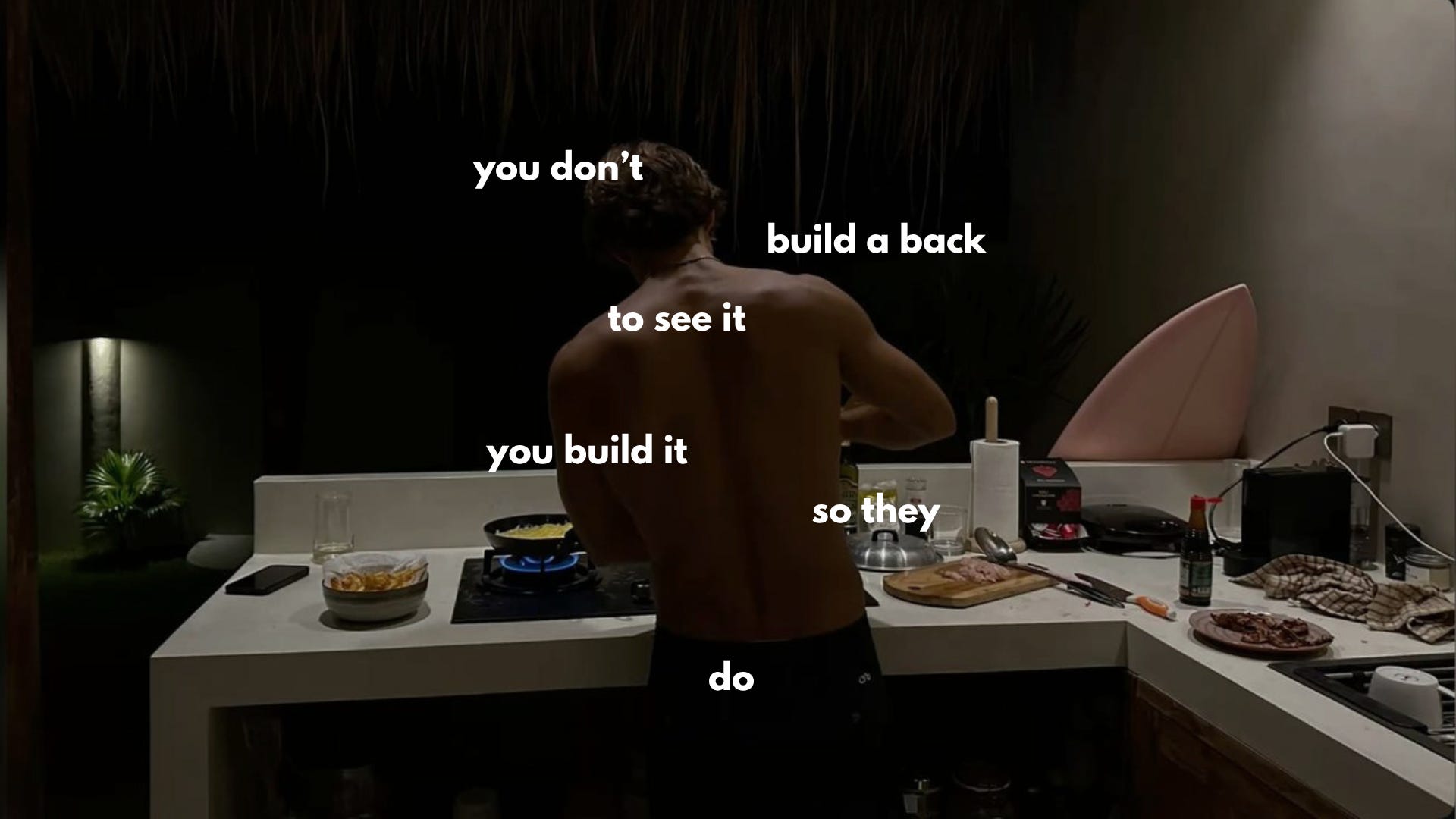
You can put in months of solid work and still pull on a shirt that hangs off you exactly like it did the day you started.
That was me for a long time. I trained the way most guys train when they’re new and want to see it working: chest, arms, the muscles in the mirror, the ones a shirt shows off from the front. And in the mirror it sort of was working. A bit more in the chest. A bit more in the sleeve. Then I’d catch myself in a photo taken from the side or from behind, and I looked exactly as narrow as I had a year before. Flat. Like someone had drawn a straight line from my shoulder down to my hip.
The mirror never tells you the part that actually matters: it only shows you the front. You stand square to it, flex what’s facing you, and walk off thinking that’s the whole picture. But nobody else sees you from the angle you see yourself. They see you from the side, from behind, moving around in a shirt. And what decides how big you read from those angles isn’t the chest you’ve been hammering three times a week. It’s the back you’ve barely touched.
Because filling out a shirt was never really about the muscles you can see. It’s about the ones you can’t.
Your back is what gives you width: the flare from the waist up to the shoulders that makes a shirt sit wide instead of straight down. It’s what gives you thickness, the density that stops you disappearing to a line the second you turn side-on. It’s most of your upper body by sheer surface area, and for most guys it’s the single least-trained thing they own, for one stupid reason. They can’t watch it work, so they never learn how.
Train the half you can’t see, and you stop being the guy whose shirt just hangs there and start being the one it actually fits.
THE WHOLE IDEA
If you take one thing from this before we get into the lifts, take these three.
Width and thickness are two different jobs. Width is the flare that makes you look wide from the front. Thickness is the density that makes you look solid from the side. Different muscles, different movements, and you need both or you only ever half-fill the shirt.
A back is built by pulling, and by pulling heavy. Everything back there grows in response to one thing: dragging a real load toward you, over and over, and adding to it over time. Machines and light cables have their place, but the load is what does the building.
You’ll never watch it work, so you train it on feel. You can’t see your back mid-set the way you can watch a bicep curl. That’s the whole reason it gets skipped and half-repped. Slow down, feel the pull start in the muscle instead of the arms, and it grows like anything else does.
The rest of this is those jobs in order: build the width, build the thickness, then stop skipping the small stuff at the back that holds all of it together.
BUILD THE WIDTH
Width is the lats. They’re the big fan-shaped muscles that run from low on your spine up and out to your arms, and when they grow they do two things at once: push your arms out a little wider and flare up from your waist. That flare, narrow at the bottom and wide at the top, is the whole V shape, and it’s the single biggest reason one guy looks broad in a plain shirt and another looks straight up and down. You build it by pulling down: anything where your arms travel from overhead to your sides against a load.
Pull-ups build it fastest. Nothing loads the lats like hauling your whole bodyweight up to a bar. If you can’t do many yet, that’s normal, and it’s the exact lift most worth being bad at for a while. Use a band under your feet or the assisted machine, work toward three honest sets of six to ten, and keep chipping at it. Drive your elbows down to your ribs instead of reaching with your chin, and let the stretch happen at the top rather than dropping straight into the next rep.
Lat pulldowns build it while you get there. Same movement, but you set the load, so you can hit real volume with clean form from day one. Grip a bit wider than your shoulders, pull the bar to your upper chest, and think about driving your elbows down and back, not yanking with your hands. Two or three sets of eight to twelve, adding weight when the top of that range starts to feel easy.
Straight-arm pulldowns teach you where your lats actually are. This is the one that fixes the “I don’t feel my back, I just feel my arms” problem. Stand at a cable, arms nearly straight, and push a bar down to your thighs in an arc using only your lats, no bending at the elbow. It’s light and it looks like nothing, but done slow it lights up the exact muscle you’ve been missing, and that carries into every other pull you do. Two sets of twelve to fifteen, unrushed.
BUILD THE THICKNESS
If width is what you see from the front, thickness is what you see from the side. It’s the meat across the middle of your back, the muscle sitting between your spine and your shoulder blades, and it’s what stops you looking flat as a board the second you turn. Width came from pulling down. Thickness comes from pulling in: dragging a weight toward your torso while the rest of you stays put. These are the lifts that pack actual mass back there, so this is where the load matters most.
The barbell row is the big one. Hinge at the hips until your torso is somewhere near parallel to the floor, let the bar hang, and row it into your belly button, then control it back down. It hits the whole back at once and lets you move real weight, which is exactly what thickness wants. Keep your back flat and your neck neutral, and pull with your elbows, not your hands. Three or four sets of six to ten, and don’t be shy about adding weight here.
One-arm dumbbell rows fix your weak side. A hand and a knee on a bench, a dumbbell in the other hand, and you row it up to your hip one side at a time. Working one arm at a time means your stronger half can’t quietly take over, and you get a longer stretch at the bottom and a harder squeeze at the top than a barbell allows. Let the weight pull your shoulder blade forward at the bottom, then drive the elbow up and back. Three sets of eight to twelve each side.
Chest-supported rows let you go all-out with nothing to cheat. Lie face-down on an incline bench and row a pair of dumbbells or a bar up toward you. Because the bench holds your torso, nothing swings and nothing gives out early: it’s pure mid-back. Reach for this later in the session, when the standing rows have taxed everything holding you upright and you want to keep hammering the back without your lower back quitting first. Two or three sets of ten to twelve, squeezing your shoulder blades together hard at the top.
DON’T SKIP THE BACK OF THE BACK
Width and thickness build the mass. This last bit is what makes it look finished, and what makes you carry it well. It’s the smaller muscles up top and along your spine: the rear delts, the traps, the long muscles either side of your backbone. Nobody trains them directly because nobody can see them, and it shows. Plenty of guys with a decent back still round forward at the shoulders and give the whole thing away. Spend a little here and you don’t just look bigger, you stand like it.
Face pulls fix your posture while they build your rear delts. Set a cable or a band about head height, grab the rope, and pull it straight toward your face with your elbows high and wide, splitting the rope apart as it comes in. It hits the rear delts and the small muscles that draw your shoulders back, so it slowly undoes the hunch a desk and a phone put on you. Do them often and light, two or three sets of fifteen to twenty, a few times a week if you want. Cheapest upgrade to how you stand there is.
Deadlifts tie the whole back together. Load a bar on the floor, hinge down with a flat back, and stand up with it. There’s no better builder for the deep muscles along your spine and the thickness up through your traps, and it teaches your entire back to brace and work as one piece. Start lighter than you think and get the movement grooved before you chase a number, because this is the one lift where rushing the load just trains you to pull it badly. One or two hard sets of five is plenty, once a week.
Shrugs fill out the collar. Hold a heavy pair of dumbbells or a bar at your sides and lift your shoulders straight up toward your ears, pause at the top, lower under control. This builds the upper traps, the muscle that gives you the line from neck to shoulder and makes a collar sit full instead of loose. Skip the rolling, it does nothing but look busy. Three sets of ten to fifteen, heavy enough that the last couple are a grind.
And the free part: stand up straight. The best back in the room disappears the second its owner rounds forward over it. Pull your shoulders back, stack your head over them, and everything you built back there finally gets seen.
You can’t see your back. That’s exactly why it’s the half everyone skips, and the half that makes you look big.
THE BACK SESSION
Everything above sorts into three jobs. Here’s the whole map on one screen:
Width. Flares the shirt at the shoulders, the V. Built with pull-ups, lat pulldowns, and straight-arm pulldowns.
Thickness. Fills it out front-to-back, the part you read from the side. Built with barbell rows, one-arm dumbbell rows, and chest-supported rows.
The detail. Finishes it off and fixes your posture. Built with face pulls, deadlifts, and shrugs.
One back day a week gets most guys a long way. Two if it’s your weak point. A session that covers the lot:
One vertical pull (pull-ups or lat pulldowns): 3 sets, 6 to 12 reps.
One heavy row (barbell or one-arm dumbbell): 3 to 4 sets, 6 to 10 reps.
One supported row (chest-supported): 2 to 3 sets, 10 to 12 reps.
Deadlifts: 1 to 2 hard sets of 5, once a week (not every back day).
Face pulls and shrugs to finish: 2 to 3 sets each, 12 to 20 reps.
The only rule that really matters: add a little every week. A rep, a few pounds, one cleaner set. A back grows on load going up over time, and almost nothing else.
WHAT FILLS OUT
None of this shows up overnight, and that’s fine, because the back is slow and it’s honest. Give it a few real months of pulling heavy and adding a little each week, and you start noticing it in odd places before you ever notice it in the mirror. A shirt that used to hang goes snug across the top and loose at the waist. Someone says you look like you’ve grown and you can’t work out where, because your arms are the same as they were. You catch a photo from the side, the one angle that always used to flatten you, and there’s a shape there now. The V you were chasing from the front turns out to have been built from behind the whole time.
You were never training the wrong way. You were only ever training half of yourself.
RBLT
Let’s talk. Be honest about your split: does back get its own day, or is it the thing you tack on when there’s time left over?
Tell me in the comments. Half the fix is just admitting which one it’s been.
About RBLT
The fitness world is very good at making a simple thing feel impossible. RBLT is the simple version of getting in shape: how to train, eat, sleep, handle your head, and hold a standard, in plain language, none of the noise. If you’re done chasing the next hack and just want to get in shape and get on with your life, you’re in the right place.